
Choose the Material Around the Complete PCB Requirement
Choosing a high Tg PCB manufacturer involves more than asking for the highest glass-transition temperature on a quotation. OEM engineers and B2B purchasing teams need a documented FR-4 construction that suits assembly exposure, operating conditions, electrical performance and the approved fabrication process. Tg is one useful material property; it is not a complete reliability specification.
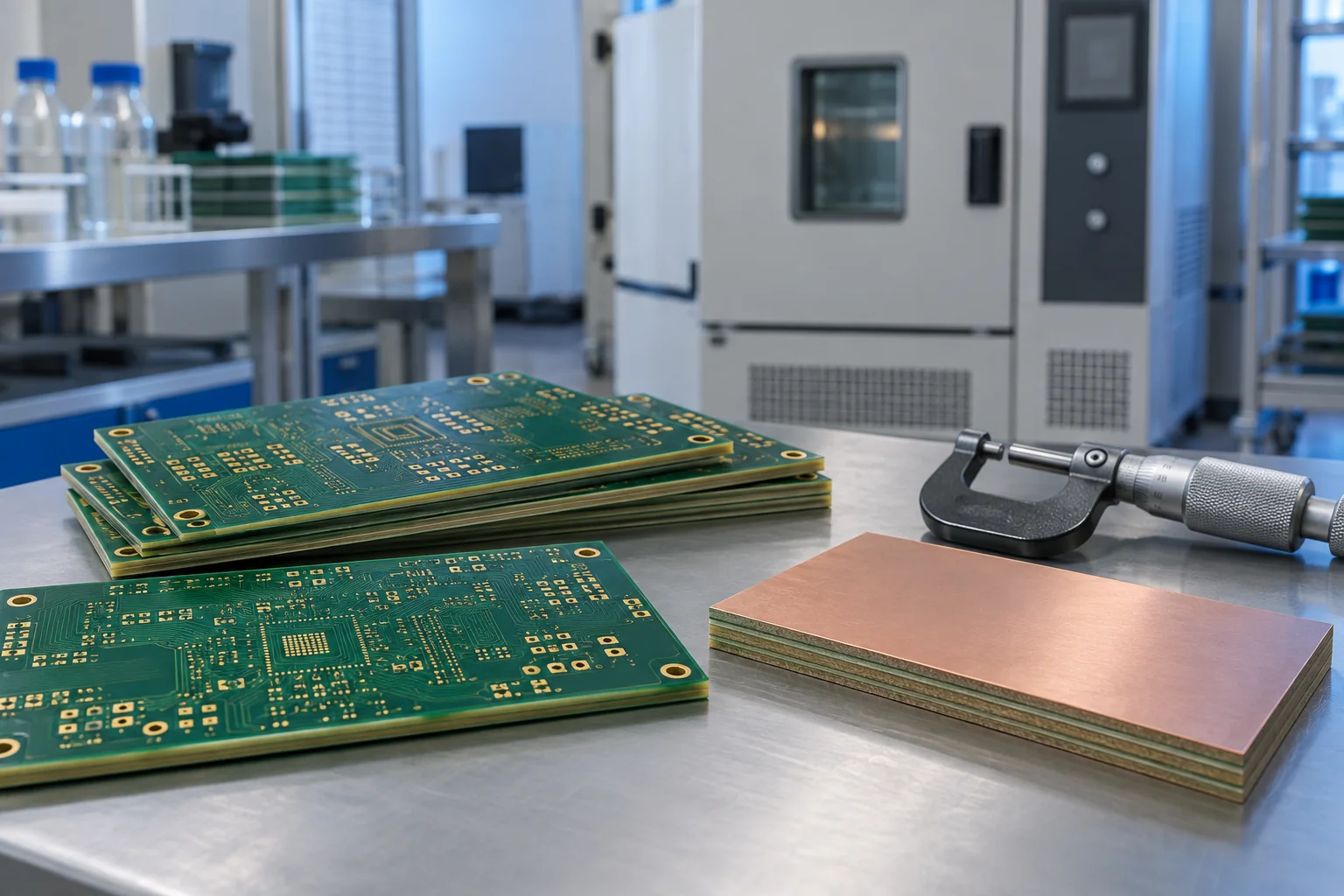
This guide explains how to compare thermal data, define acceptable alternatives and request a meaningful material review. Start with the application and released board construction, then agree what the supplier must verify. A higher number can be useful when it addresses a real requirement, but it cannot replace the engineering checks behind the selection.
XinshunPCB’s rigid PCB manufacturing services provide the commercial starting point for custom multilayer boards. For layer order, dielectric spacing and reference planes, use the PCB stackup design guide alongside this material-selection checklist. The two decisions should be approved together.
Understand Tg Without Treating It as an Operating Limit
Glass-transition temperature describes a transition in the polymer resin’s behavior. Around that region, material stiffness and thermal expansion behavior change. It does not mean the laminate suddenly melts, and it does not define one universal maximum service temperature for the finished electronic assembly.
A soldering profile can briefly exceed Tg. Whether a particular board construction tolerates that exposure depends on the material system, moisture condition, time and temperature profile, copper and hole construction, and the number of assembly or repair cycles. Do not turn a Tg value into a pass/fail rule for every reflow process.
Compare measurement methods before comparing numbers. DSC, DMA and TMA evaluate different responses, so the reported transition values are not automatically interchangeable. In Shengyi’s S1000-2M technical data sheet, the same material has typical Tg values of 180°C by DSC and 185°C by DMA. That is a useful example of why the method belongs beside the value, rather than a reason to rank two grades using unlike tests.
Terms such as standard, mid-Tg and high-Tg are useful market descriptions, but the purchase specification should identify the grade, required properties and test basis. If a minimum Tg is mandatory, write the value and method explicitly. Otherwise, the designer and supplier can both say “high Tg” while approving different requirements.
Compare Thermal and Electrical Properties Together
Build a short comparison around the risks your design actually faces. Separate resin transition, decomposition, expansion and time-to-delamination data. Add electrical and insulation requirements when they are important to the circuit. These checks answer different questions and should not be reduced to a single material score.
| Property | What to review | What it does not establish alone |
|---|---|---|
| Tg and test method | Resin transition and the basis of the reported value | Maximum assembly temperature or product service life |
| Td | Decomposition data and the stated test endpoint | An allowable continuous operating temperature |
| Z-axis CTE and total expansion | Expansion through the board thickness over the relevant range | Reliability of every plated-hole geometry |
| T260 / T288 | Time-to-delamination test conditions and results | The number of acceptable reflow or repair cycles |
| Dk and Df | Frequency, test method and relevant laminate construction | Low-loss performance just because Tg is high |
| Moisture, insulation and CTI | Properties required by the environment and electrical design | Whole-product insulation compliance or a universal creepage distance |
The official Isola 370HR material data lists thermal, electrical and moisture properties separately. Its Tg is measured by DSC, while Td uses a specified weight-loss endpoint. Use the current data sheet and construction information for the proposed grade; a product summary is not the entire purchasing specification.
A high-Tg FR-4 grade is not automatically a low-loss laminate, a high-CTI material or a high-thermal-conductivity solution. Define those requirements independently. If a design is constrained by signal loss or heat removal, ask whether the material family itself is appropriate before selecting a grade within it.
Connect Material Selection with Stackup and Via Construction
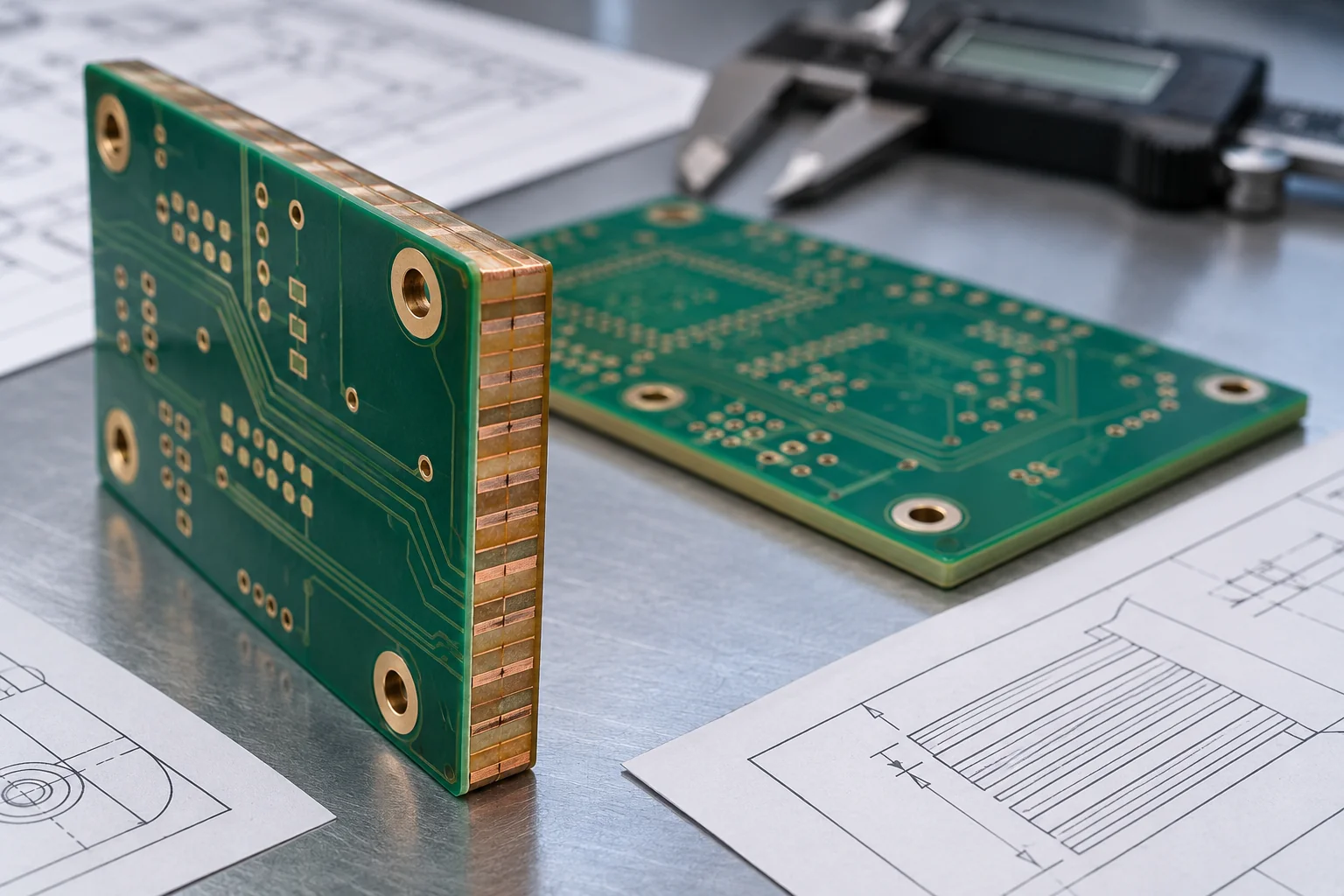
The chosen laminate must work in an achievable multilayer build. Agree the core and prepreg construction, pressed dielectric thicknesses, finished board thickness, copper requirements and via spans. A material name without its proposed construction leaves important electrical and manufacturing assumptions unresolved.
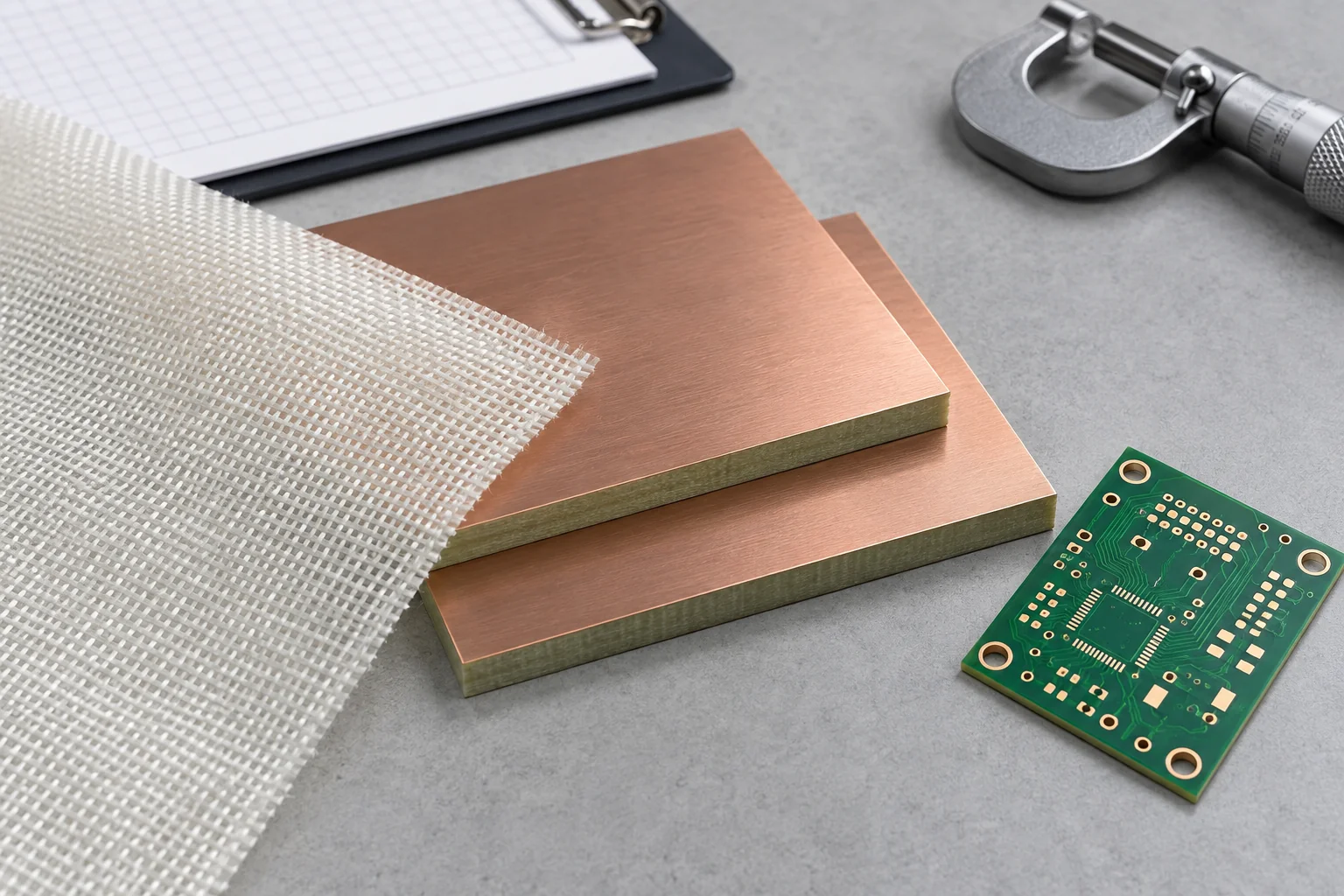
For a thicker multilayer board, review hole diameter, span and copper plating requirements together with thermal expansion. A favorable laminate data sheet does not establish that every hole aspect ratio or stacked-via configuration is reliable. Ask the fabricator to review the actual geometry and the applicable verification requirements.
When a grade or prepreg construction changes, revisit the assumptions behind impedance and finished thickness. Keep the material approval linked to the released stackup revision. Avoid accepting an alternative because only its Tg matches while dielectric properties or available constructions differ.
The rigid PCB manufacturing capabilities page provides XinshunPCB’s process context. Request confirmation for the complete combination of material, layers, copper and hole features; separate published limits should not be assumed to apply simultaneously to one design.
Review Assembly Exposure and the Real Operating Environment
Describe manufacturing exposure separately from field operation. The first includes soldering, possible second-side processing, selective soldering and permitted repair. The second includes expected board temperatures, thermal cycles, humidity, contamination and electrical bias. Each may influence the review, but they are not the same test.
- Assembly: provide the intended temperature profile, number of exposures and any approved rework assumptions.
- Field use: identify expected temperature range, hot regions, duty cycle and environmental conditions.
- Construction: highlight thick boards, long plated holes, heavy copper or other features that need special review.
- Acceptance: agree what evidence or tests are required and whether a customer qualification constrains the material.
For an industrial control board, a material selected for assembly robustness still needs a review of the enclosure temperature and local component heating. Increasing Tg does not remove those heat sources. Conversely, a brief manufacturing temperature peak should not be treated as the product’s continuous temperature requirement.
Agree storage, moisture handling and any drying procedure with the supplier using the relevant material and board instructions. Do not apply one generic bake schedule to every surface finish or construction. If conditioning is necessary, specify the approved process and ownership instead of leaving it to an informal assumption.
Approve Material Alternatives and Supplier Controls
A useful high Tg PCB manufacturer should explain the proposed grade, its available constructions and how an alternative will be approved. Ask which requirements are controlled by the fabrication drawing, which are supplier proposals, and what documentation connects the manufactured lot to the approved material.
Distinguish an approved alternate from an unrestricted substitution. For a fixed customer-qualified design, the exact grade may be mandatory. For a new design, engineering may allow an alternative after reviewing thermal, electrical and construction differences. Record that decision before manufacturing; a similar marketing label is not written approval.
- Identify the proposed laminate and prepreg family, with the current data-sheet revision.
- Compare required values using compatible methods and conditions.
- Check the proposed layer construction and any changed impedance assumptions.
- Confirm material identification, manufacturing records and required reports.
- Assign an engineering approval owner and a change-notification requirement.
Also ask whether an alternative changes delivery assumptions, cost or qualification work. The PCB manufacturing cost guide helps purchasing separate construction changes from a like-for-like price comparison. A cheaper offer is only comparable when the material and acceptance scope are clearly aligned.
Prepare a High-Tg FR-4 RFQ and Release Checklist
Send the supplier the design information needed to evaluate the build, rather than only a desired Tg. Include usable fabrication artwork, drill data, the outline, a proposed or fixed stackup, copper and finish requirements, quantities and the requested schedule. Mark unresolved requirements as open questions.
- Material: exact grade when mandatory, or required properties and approved-alternative conditions.
- Thermal basis: Tg minimum and method where required, plus other project-specific thermal criteria.
- Electrical basis: impedance structures, loss requirements and the relevant frequency or construction assumptions.
- Mechanical build: layer count, thickness, hole spans and special via processes.
- Process exposure: assembly and repair conditions that must be considered.
- Documentation: revision control, traceability and any agreed verification or qualification reports.
Use the PCB quotation file checklist for the complete RFQ package. Ask the supplier to identify exceptions and proposed adjustments in writing. Keep a preliminary material recommendation separate from the final manufacturing release.
Before repeat production, reconcile the material, stackup and fabrication revisions actually approved for the prototype. Document any changes made during engineering review and decide whether they affect qualification. This gives purchasing a controlled repeat-order basis instead of relying on an old quote description.
Request a Project-Specific High-Tg PCB Material Review
XinshunPCB’s rigid PCB portfolio includes multilayer industrial control and other application examples. Use them to start a discussion about material and construction; they do not establish that a particular grade is stocked for immediate delivery or that its data-sheet properties guarantee your finished assembly.
For an actionable review, explain whether the material is fixed by customer approval or can be changed before layout release. Send the current files, important thermal and electrical constraints, quantities and timing. Request the proposed material, construction and inspection scope together.
Request a high-Tg FR-4 PCB material and manufacturing review with your design package. A clear material decision should identify the grade, the requirements it meets, the approved stackup and the conditions for any later substitution.
High-Tg FR-4 PCB Material FAQs
Answers to common questions about Tg, soldering exposure, material alternatives and preparing a custom rigid PCB quotation.